
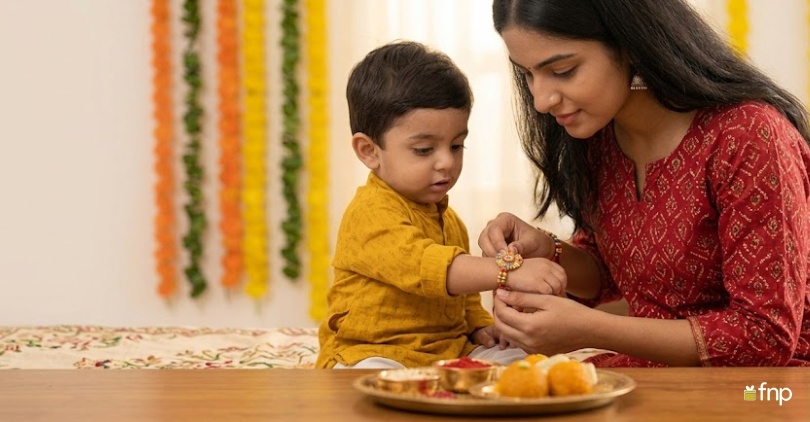
Ask most people who can you tie rakhi to, and the answer that comes back almost automatically is “brother.” It’s the image everyone grows up with, a sister tying a thread on her brother’s wrist, him promising to protect her, sweets exchanged, a small gift handed over. But if you actually look at how Raksha Bandhan is practiced across India, the thread has never really been limited to that one relationship. It’s stretched, bent, and reinterpreted by families for generations, and honestly, that flexibility is part of what makes the festival so enduring. Here’s a look at who the tradition actually includes once you move past the obvious.
- Rakhi for a Brother-in-Law – One of the oldest extensions of this tradition is the lumba rakhi, tied by a sister to her brother-in-law, or by a sister-in-law to her husband’s brother. It’s such a well-established custom in many North Indian households that entire product lines exist just for this relationship. The bond it represents isn’t blood, but it’s treated with the same seriousness, a way of formally welcoming someone into the family fold.
- Rakhi for Cousins – In big joint families, there will be instances when the cousins grow up closer than brothers and sisters, and the rakhi tying ceremony is conducted according to the reality of life with no objection raised. Regardless whether your first cousin was someone who you used to play with when you were young and living down the street or a distant cousin whom you see on holidays, tying rakhis on a cousin is totally fine and acceptable.
- Rakhi for Close Friends – This is probably the fastest-growing version of the question of who can you tie rakhi to in recent years. Close friendships, especially ones that have lasted since childhood or college, increasingly get formalised through rakhi. Some call it a “rakhi friendship,” and it carries real weight, a public, symbolic acknowledgment that this person matters as much as family does, even without shared blood or last names.
- Rakhi Between Sisters – Traditionally uncommon, but growing more visible, sisters tying rakhi to each other has started appearing in modern households, particularly in families without brothers. Instead of skipping the tradition entirely, sisters have adapted it to fit their own relationship, tying it to each other as a mark of their bond rather than following a rigid brother-only rulebook.
- Rakhi for Soldiers – Every year, thousands of rakhis are sent to soldiers stationed at borders, often by people who have never met the recipient personally. Schools, NGOs, and families organise these gestures as a way of extending the sentiment of protection and gratitude beyond personal relationships entirely. It’s become one of the more emotionally resonant modern additions to the tradition, turning a family ritual into something with national symbolism.
- Rakhi for Teachers and Mentors – Some students choose to tie a rakhi to a teacher or mentor who has played a genuinely protective, guiding role in their life, particularly in cases where that person filled in for an absent sibling or family member. It’s not the most common version of this tradition, but it shows up often enough in schools and smaller communities to be worth mentioning.
- Rakhi for Trees and Nature – There’s also a lesser-known but genuinely old tradition of tying rakhi to trees, symbolising a vow to protect nature. Some environmental groups have revived this practice in recent years as a way of using a familiar cultural ritual to spark conversations about deforestation and conservation. It sounds unusual at first, but the underlying idea, a rakhi as a symbol of protection extended beyond people, fits the spirit of the festival perfectly.
Why the Tradition Keeps Expanding
What’s actually driving all this isn’t confusion about the rules. It’s that Raksha Bandhan was never built around bloodlines in the first place, it was built around the idea of protection and mutual care, and any relationship that carries that weight tends to earn a place in the ritual eventually. Migration plays a part too. As families spread across cities and countries, the people who show up for you day to day aren’t always the ones you grew up calling family, and the festival has quietly stretched to make room for that. It’s less a departure from tradition and more the tradition doing exactly what it was always meant to do.
Culturally, there’s no religious text or binding rule that restricts who can you tie rakhi to strictly to biological brothers. What actually defines the ritual is the promise embedded in it, protection, care, and a bond worth formally acknowledging. Families, communities, and even individuals have shaped the tradition around their own relationships for generations, which is exactly why it still feels relevant today instead of outdated.
Choosing a Rakhi for Different Relationships
Whoever you’re tying a rakhi to this year, the thread itself matters less than the thought behind picking it. If you’re shopping around, you’ll find it easy to buy rakhi in styles ranging from traditional threads to modern, minimalist designs, so the choice can reflect the specific relationship you’re celebrating rather than a generic one-size-fits-all option. A rakhi picked for a childhood friend doesn’t have to look the same as one picked for a sister-in-law or a cousin, and most collections today are built with exactly that kind of variety in mind.
And if the occasion calls for something more, rakhi gift hampers bundling sweets, dry fruits, or chocolates alongside the rakhi tend to make the whole gesture feel a little more complete. This is especially true when you’re celebrating someone who isn’t a “traditional” sibling but matters just as much, a hamper adds a bit of extra warmth to a relationship that might not have decades of shared family history behind it, but deserves the gesture all the same.
At the end of the day, Raksha Bandhan has always been less about strict eligibility and more about who you choose to protect and be protected by, and that list has always been longer than just brothers.


