
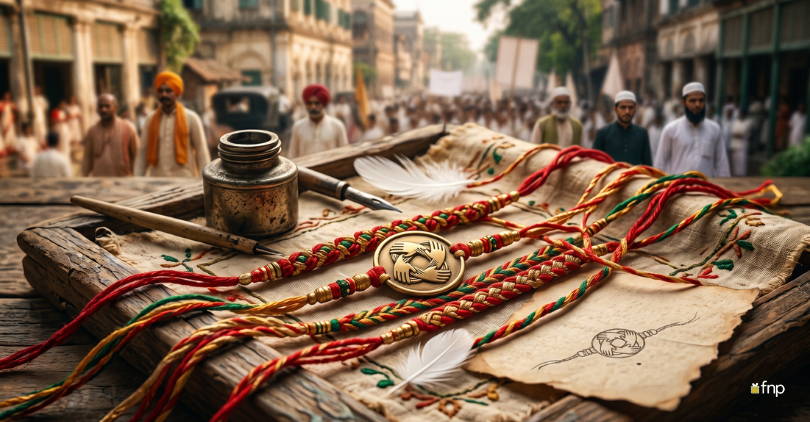
Raksha Bandhan is often associated with brothers, sisters, sweets, and family gatherings. Yet, there was a time when a simple rakhi carried a message far bigger than a family tradition. In 1905, it became a symbol of unity at a moment when Bengal stood divided, both politically and emotionally. The story of Rabindranath Tagore’s Raksha Bandhan is one of the lesser-known chapters of India’s freedom movement, where a festival was transformed into a peaceful act of resistance.
More than a century later, it continues to remind us that traditions often carry meanings beyond the rituals we know today.
The Background: Why Was Bengal Being Divided?
In 1905, the British government, led by Lord Curzon, announced the Partition of Bengal. This partition was a decision on administrative grounds since Bengal had become too large for proper governance.
Many Indians, however, believed there was another reason behind the decision. Bengal had become an important centre of the growing nationalist movement, and the partition was widely seen as an attempt to weaken that unity. The division separated the largely Hindu western region (West Bengal, Bihar and Odisha) from the predominantly Muslim eastern region (Assam and Sylhet (now in Bangladesh)), creating concerns that religious differences would be used to create social divisions. The announcement triggered widespread protests across Bengal.
Tagore Chose Unity Over Protest
While many leaders organised meetings, demonstrations, and public campaigns, Rabindranath Tagore chose a different path. Rather than confrontation, he chose a tradition that everybody knew and understood. Raksha Bandhan meant trust, safety, and human relations.
The story of Rabindranath Tagore’s Raksha Bandhan was not an attempt to redefine its meaning. On the contrary, it was an attempt to widen its scope since Tagore saw this ceremony as an act of mutual solidarity among different communities irrespective of their backgrounds.
A Rakhi Beyond Brothers and Sisters
On 16 October 1905, the day the Partition officially came into effect, Tagore encouraged people to tie rakhis to one another as a public expression of unity.
Men tied rakhis to other men. Women tied rakhis to neighbours. Hindus and Muslims exchanged the sacred thread as a sign that political decisions could not weaken the relationships they had built over generations.
People sang songs written by Tagore on Kolkata streets in processions. They did not respond angrily but rather silently and symbolically. For many participants, Rakhi did not represent family alone; it also represented shared belonging.
Why Did Tagore Choose Raksha Bandhan?
Tagore understood that festivals already carried emotional value within society. People did not need long speeches to understand the meaning of a Rakhi.
By choosing an existing tradition instead of creating a new symbol, he made the movement more accessible. The thread became a reminder that communities could stand together despite attempts to divide them.
The significance of Rabindranath Tagore’s Raksha Bandhan lies in this simple idea. A cultural tradition became part of a peaceful public movement without losing its original identity.
The Swadeshi Movement and Cultural Resistance
The Rakhi campaign became one part of the larger Swadeshi Movement that followed the Partition of Bengal.
People began supporting Indian-made products, organising public gatherings, writing patriotic literature, and promoting local industries. Tagore actively participated through poetry, music, and public engagement, believing that culture could unite people just as effectively as political speeches.
His approach showed that resistance did not always require confrontation. Sometimes, familiar traditions could communicate powerful ideas more effectively than slogans.
A Legacy That Continues Today
The Partition of Bengal was eventually annulled in 1911, although several political developments contributed to that decision. Even so, Tagore’s Rakhi campaign remained one of the most memorable responses to the events of 1905.
However, currently the festival is celebrated within families, but we know that Raksha Bandhan held a very deep social meaning in the past. The concept of faith, respect, and unity was one of the hardest times in India’s history.
This story of Rabindranath Tagore’s Raksha Bandhan is still popular because it represents an alternative perspective on a familiar festival. It shows how traditions evolve to meet the needs of the time while preserving cultural roots.
Why This Story Still Matters
Most history books mention only political actions like speeches, decrees, and protests in relation to significant historical events. Tagore took another path – he picked up the thread that already symbolized protection and gave it a larger meaning without changing its essence.
Even today, Raksha Bandhan ties up distant families across cities and even countries. Although Raksha Bandhan has evolved into an occasion where presents are exchanged and the convenience of ordering rakhi online, the significance of Rakhi lies in the relationship and mutual care. Reflecting on the year 1905 adds yet another dimension to our understanding, for the same thread had turned into a symbol of harmony amidst a crucial moment in the history of Bengal.
Some stories become part of history because they change governments. Others are remembered because they change the way people think. Tagore’s Rakhi movement belongs to the second kind. It transformed an everyday tradition into a peaceful expression of unity, leaving behind a legacy that continues to give Raksha Bandhan a place not only in family celebrations but also in India’s cultural and historical memory.


