
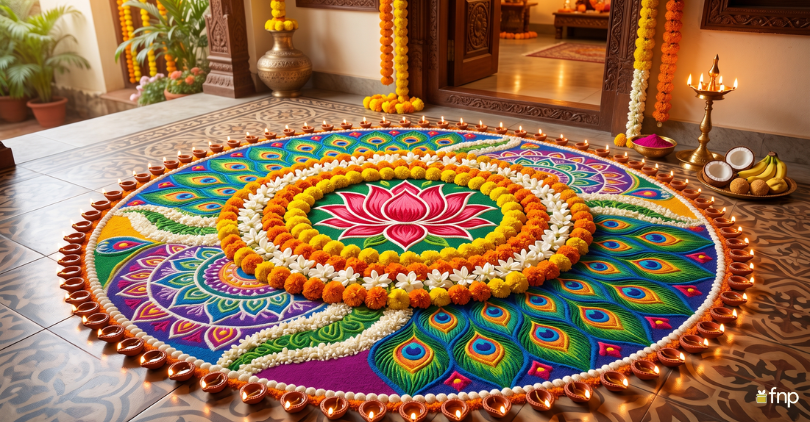
No matter how elaborate the mandap inside gets, it’s the rangoli at the entrance that usually sets the tone for the whole festival. It’s the first thing Bappa, and every guest walking in, actually sees. If you’re looking to switch things up from the same dots-and-lines pattern you’ve used for years, there are plenty of rangoli designs for ganesh chaturthi that are simple enough to finish in under an hour but still make a real impression. Most of them don’t need any special tools either, just what’s already sitting in the kitchen or the garden.
Five Creative Rangoli Designs Worth Trying This Year
A beautiful rangoli at the entrance is a lovely way to welcome Ganpati Bappa into your home. From traditional patterns to more creative designs, there are plenty of ways to make your entrance feel festive. Here are five rangoli ideas you can try this Ganesh Chaturthi.
Floral Petal Rangoli
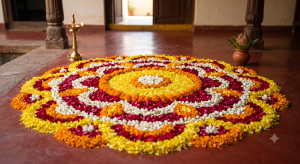
A floral petal rangoli is probably the easiest place to start if you’re short on time or patience. Instead of using powder colours, you work entirely with flower petals, marigold, rose, and mogra layered in circular rings around a central point. It looks far more textured than powder rangoli and has the added benefit of being compostable once the festival wraps up, so there’s no scrubbing coloured powder off the floor afterward.
Lotus (Kamal) Rangoli
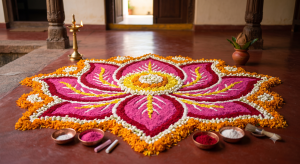
A lotus motif is a deeply auspicious choice that beautifully honors the festival while keeping the floor design purely symbolic, which is perfect if you want to avoid drawing a deity where people might walk. Most people sketch the curved, overlapping petals lightly in chalk first before filling them in with vibrant pink, red, and white rice flour or petals. It doesn’t need to be perfectly symmetrical to look good. A slightly free-flowing lotus, done with care, tends to look far more organic and charming than a flawless stencil-traced one anyway.
Peacock-Themed Rangoli
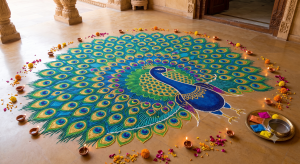
A peacock-themed rangoli works nicely if you want something colourful without going the devotional route directly. Peacocks carry their own auspicious symbolism, and the design lends itself naturally to bright blues, greens, and golds, which photograph beautifully against a plain floor. It’s also a good pick if kids in the house want to help, since the feather patterns are repetitive and easy to hand off to a second or third person to fill in.
Diya-Bordered Rangoli
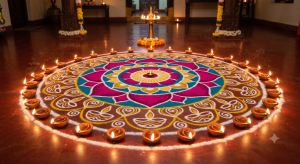
A diya-bordered rangoli takes a simpler central motif, a lotus or a small om symbol works well, and surrounds it with a ring of tiny diyas drawn or placed directly into the design. Once the actual diyas are lit in the evening, the whole rangoli takes on a completely different look, which makes it a good choice if you want one design that works well in both daylight and after dark.
Modak-Motif Pattern
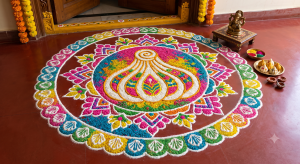
Among the more playful rangoli designs for ganesh chaturthi, a modak-motif pattern leans into the festival’s most recognisable sweet instead of the usual flowers or geometric patterns. Drawing a row of modaks along the border, or filling the centre with an oversized modak outline in coloured rice, ties the design directly to the festival in a way that’s a little more playful than the traditional options. It also tends to be a hit with anyone who notices the detail, since it’s not something you see at every house on the street.
Conclusion
Colour choice matters more than people usually think while planning any of these. Bright yellows, oranges, and reds tend to photograph and glow best once diyas are lit around them in the evening, creating a beautiful setting to welcome guests and exchange ganesh chaturthi gifts. In contrast, cooler tones like blue and green can end up looking a little flat under warm lamplight. If you’re torn between a couple of colour schemes, it helps to test a small section first under whatever lighting you’ll actually be using that evening, rather than deciding purely based on how it looks in daylight.


